F4100 Embedded Scan Module: Payment and Pickup Codes on Vending Machines
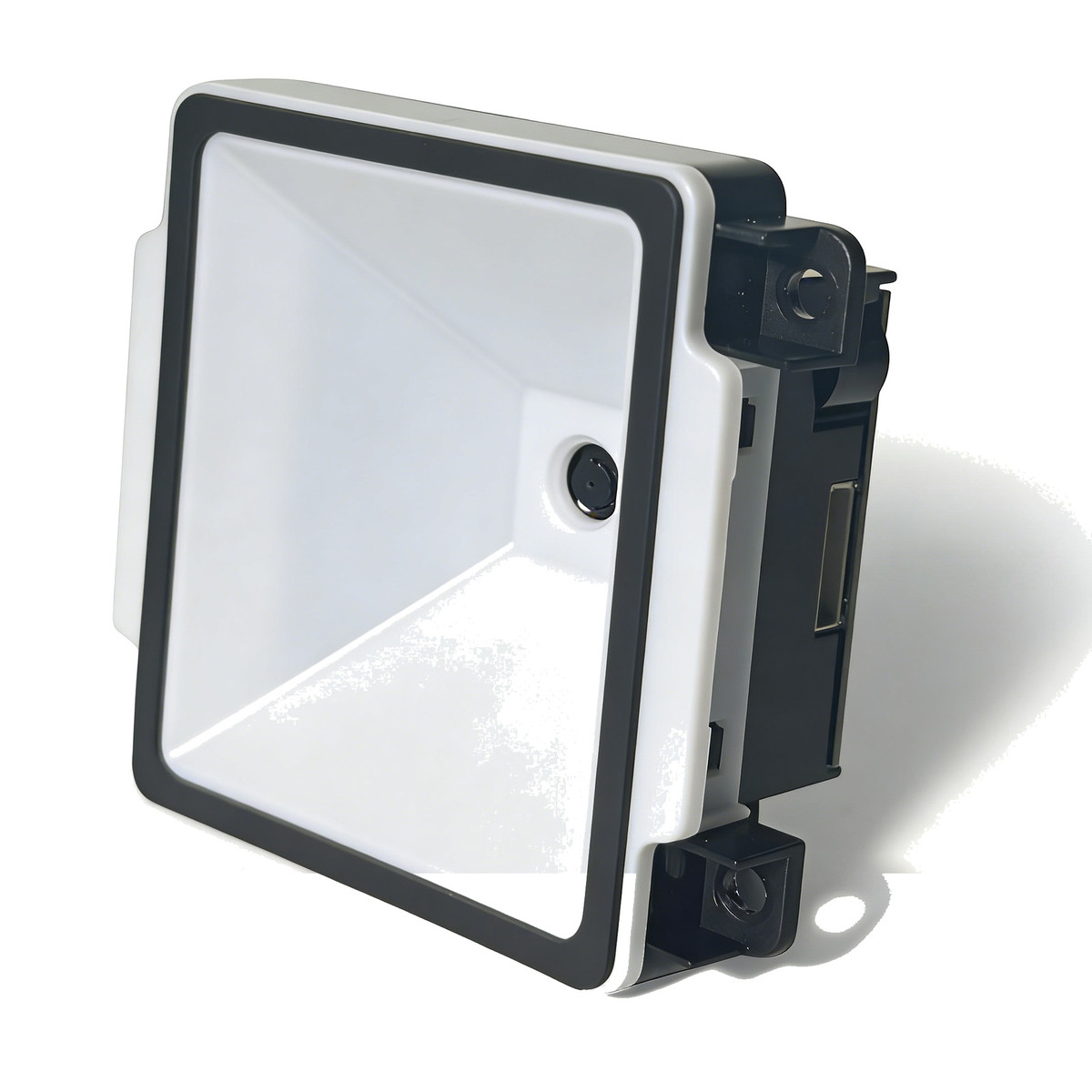
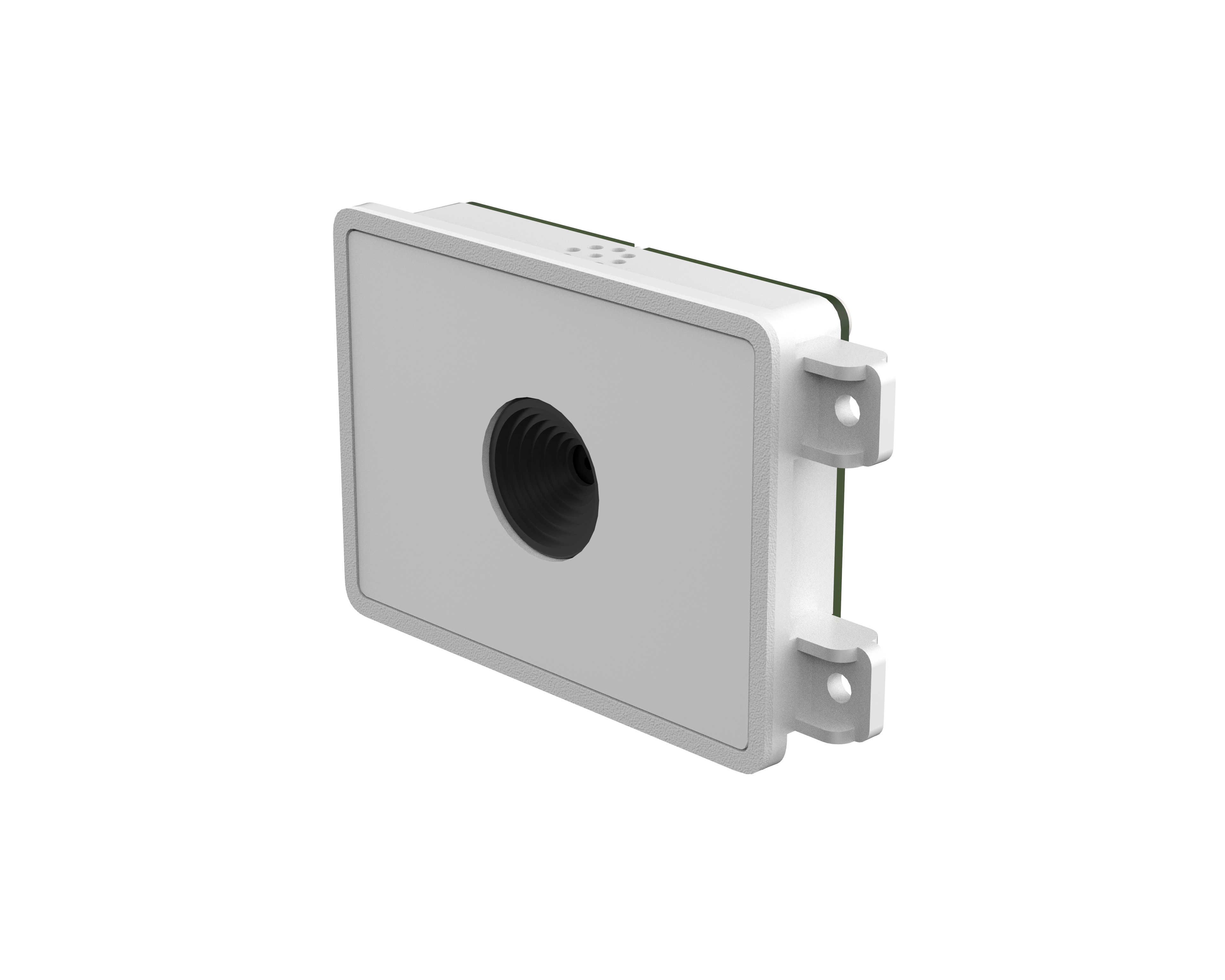
On a vending machine the busiest part is rarely the touchscreen — it is the payment window. Customers scan to pay, redeem a coupon or release an order, and restockers scan lane labels to reconcile stock. All of it starts in a window a few centimetres wide. F4100 fits an 800×600 CMOS sensor into a 65×61.2×37.5 mm, 30 g body and reads both printed and on-screen codes.
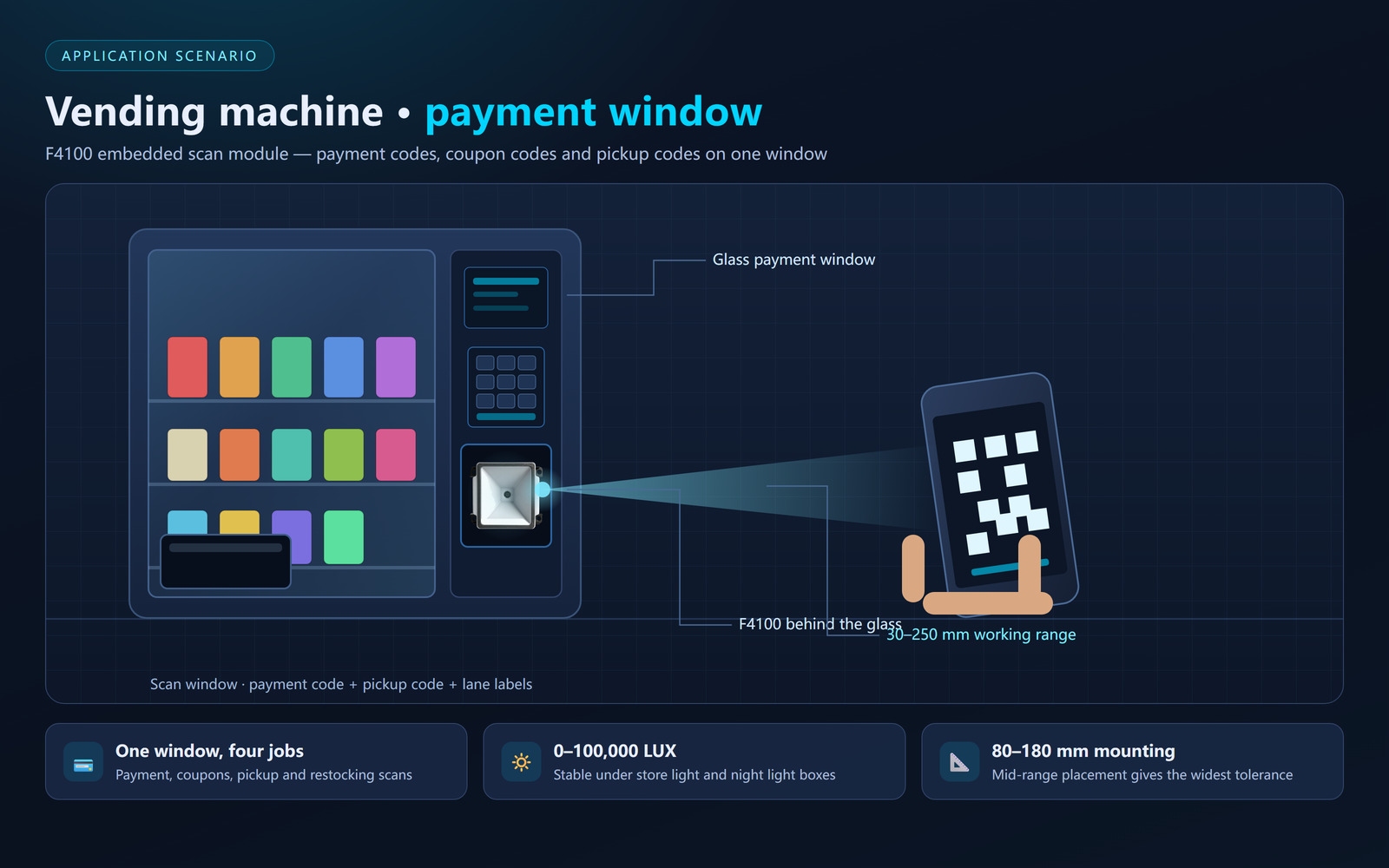
Payment window: the phone sits outside the glass, the module behind it — working range and field of view decide whether the first scan succeeds
1. Four jobs, one scan window
Payment is the most frequent: Alipay and WeChat Pay codes are on-screen codes, where brightness, refresh rate and screen protectors all affect decoding — and a failed scan usually means an abandoned purchase. Membership and coupon codes often rotate within tens of seconds, so the read has to finish inside that window. Pickup verification on pre-orders and parcel lockers mixes paper and screen codes. Service scans read lane labels — small, low-contrast Data Matrix or Han Xin codes, the hardest on the machine.
2. Three things that make field reading hard
Glass reflections and smudges. A tempered glass or acrylic layer usually sits in front of the payment window. Store lighting by day and light boxes at night create bright spots, while fingerprints and condensation weaken the signal. A module rated 0–100,000 LUX avoids the classic "works at noon, fails at night".
Screen codes are harder than paper. Auto-brightness, privacy films and ageing panels push contrast very low. The F4100 is specified at ≥20% print contrast with 4000K warm white illumination, which keeps decoding stable — but an over-tilted mounting angle still lets reflections win.
Day/night temperature swings. Outdoor machines run hot in summer and slow in winter. A -20℃ to +60℃, 5–95% RH (non-condensing) rating means one configuration works across regions.
3. Key specifications
| Item | Specification |
|---|---|
| Image sensor | 800×600 CMOS, 4000K warm white LED |
| Symbologies | QR, Data Matrix, PDF417, Han Xin, AZTEC, Maxicode; 1D EAN/UPC/Code 39/93/128/GS1 and more |
| Resolution | 1D ≥3.3 mil, 2D ≥5 mil |
| Typical range | 30–250 mm (payment code); 40–200 mm (EAN-13, 13 mil) |
| Contrast / field of view | ≥20%; ±65°, ±50° |
| Interfaces | USB, TTL232, RS232 |
| Size / weight | 65×61.2×37.5 mm / 30 g |
| Power | 5 V, 120 mA operating, 240 mA start-up |
| Environment | -20℃ to +60℃, 5–95% RH, 0–100,000 LUX |
Three numbers matter most: the 30–250 mm payment range sets how thick the window assembly can be, the ±65°/±50° field of view sets how far a customer can tilt a phone, and 120 mA decides whether the module can share a supply rail with the controller.
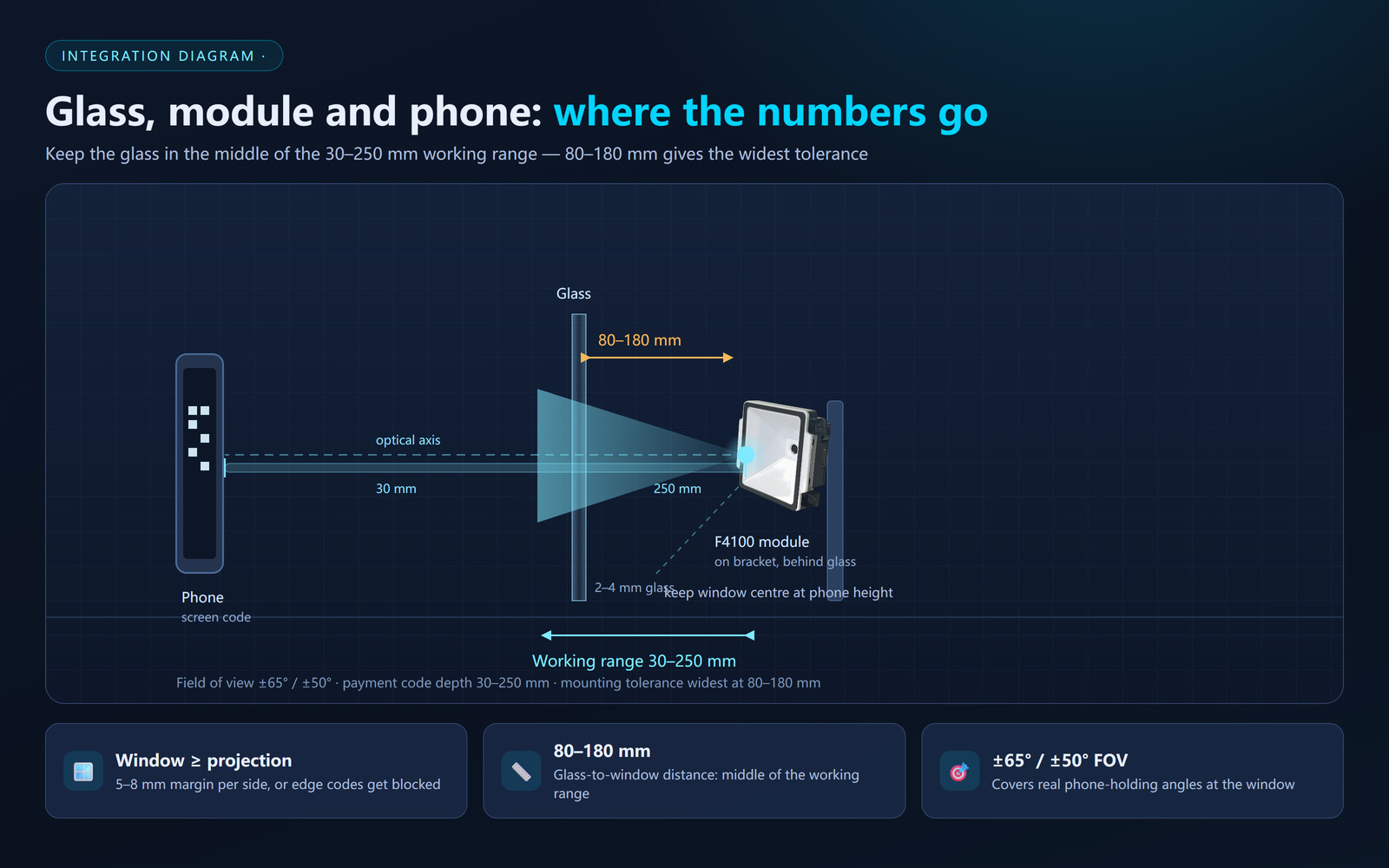
Mounting cross-section: module on a bracket behind the glass, window centre at phone height, scan path inside the 30–250 mm range
4. Four integration decisions
1. Match the window to the field of view. Coverage grows with distance at ±65°/±50°. If the opening is smaller than the field's projection on the glass, edge codes are blocked by the housing; too large and dust and stray light get in. Allow 5–8 mm of margin per side.
2. Put the glass mid-range. Both ends of 30–250 mm are marginal: too close over-exposes, too far slows decoding. A glass-to-window distance of 80–180 mm gives the widest tolerance.
3. Choose the trigger with the controller. Motion sensing suits "raise your phone and go"; TRIG suits flows that must stay in step with the UI, such as select item first and present the code second.
4. Pick the interface from the mainboard. USB for Android boards and industrial PCs, TTL232 for direct MCU connections, RS232 for long runs and legacy controllers.
5. F4100 vs XL-B4 vs E600
F4100 is the "enough room, easy to mount" option: 800×600 sensor, 30 g and a 30–250 mm range, suited to machines that also need Data Matrix and Han Xin. XL-B4 takes the thin route with a 41×22.99 mm front face for panels with tight openings, such as pole-mounted price checkers. E600 targets self-service equipment and turnstiles with a higher level of integration. Compare all three in the model comparison table, or send your panel drawing for a mounting layout.
6. Pre-launch checklist
- 50 scans each under store lighting, night light boxes and direct sun — record the failure rate, not just "it scans";
- Repeat with a low-brightness phone, one with a privacy film and an older handset;
- Confirm glass-to-window distance is 80–180 mm and the window centre matches phone height;
- Keep Data Matrix enabled — lane labels will fail without it;
- Run 72 hours continuously and watch temperature and decode speed for drift.
7. Summary
The scan window is small, but it decides whether a customer can pay and collect. Does the working range cover your window thickness, does the field of view cover real holding angles, and does it still decode in low light and low contrast? Send us the panel size, mounting distance and codes you need — samples are available for testing.
Related products
Related articles
Panel size fixed, module still open?
Tell us the window size, mounting distance and codes — free samples, order once the read rate works.
📞 Contact Xinlong IoT