Where a fixed-mount reader actually fails on a live line
On a bench, almost any imager reads a clean Code 128. On a running line, four things decide whether the station works or the operator ends up re-scanning by hand.
- Working distance drifts. A fixture moves, a part sits 10 mm higher, and the code falls outside the depth of field. The reader is fine; the geometry is not.
- The part keeps moving. Conveyor speed turns a small exposure error into a blurred code. What matters is exposure time and decode speed, not megapixels.
- Metal and gloss fight the light. Brushed aluminium, anodised frames and shrink film return specular reflections straight into the lens.
- Code quality varies by supplier. Laser DPM, dot-peen and low-contrast marks arrive from different vendors, and a threshold tuned on paper labels will miss them.
Four numbers that decide the model
1. Working range. Match the depth of field to the fixture, not to the brochure maximum. The G4503 covers 40–300 mm on EAN-13 13 mil and 30–300 mm on payment codes; the F4100 covers 40–200 mm on 13 mil. If the station can only hold 60–120 mm, a shorter-range engine gives a larger usable image at the same cost.
2. Resolution versus code size. A 5 mil Data Matrix on a metal frame needs roughly 3–4 pixels per module to decode reliably. The G4503 resolves 1D ≥ 3.3 mil and 2D ≥ 5 mil; the F42-NFC reaches 4 mil for close-range work.
3. Field of view. G4503 ±43°/±33°, F4100 ±65°/±50°, F42-NFC 74.8° H / 46.2° V. A wider field covers more of a tray but reduces pixels per module — do not use a wide lens to compensate for a badly placed fixture.
4. Interface and trigger. All three models offer USB (default), TTL and RS232. Choose the trigger mode first: command trigger from the PLC, sensor trigger at the station, continuous output on a conveyor, or an IO trigger from a photoelectric switch.
Models for fixed-position reading
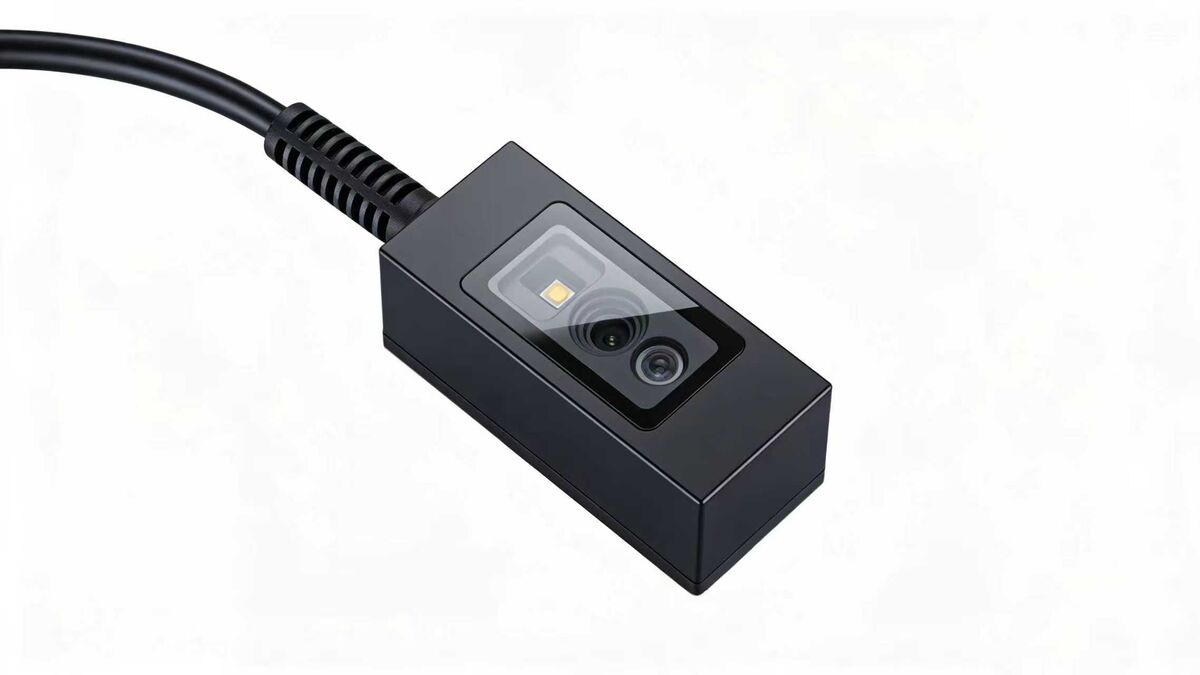
G4503
Compact fixed-mount reader for tight fixtures on 3C lines, lockers and self-service cabinets — 1600 × 1200 CMOS in a 49 × 21 × 16.8 mm body.
- 1600×1200 CMOS, 1D ≥3.3 mil / 2D ≥5 mil
- 40–300 mm on EAN-13 13 mil
- 49×21×16.8 mm, 75 g
- USB / TTL / RS232
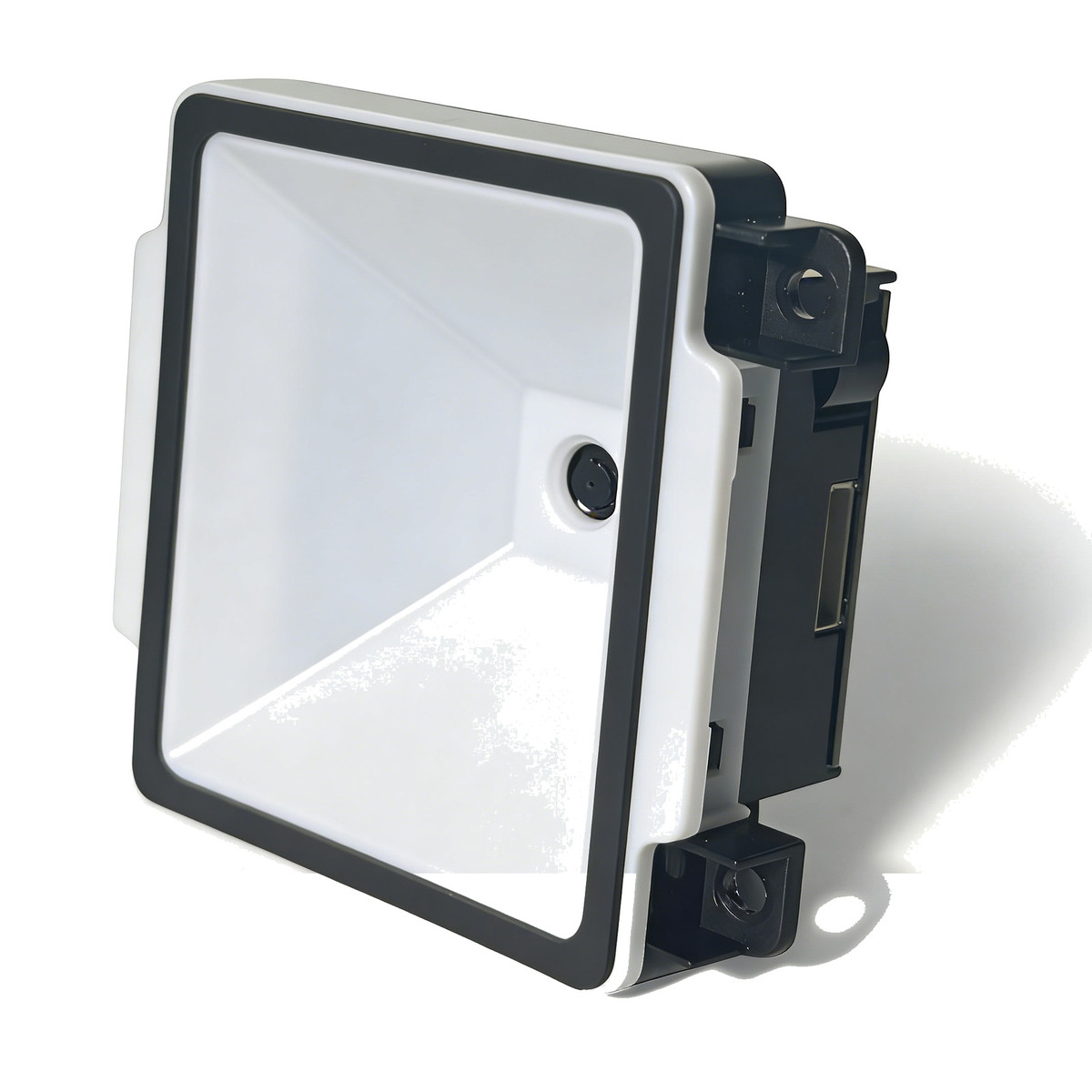
F4100
Embedded engine with 4000 K warm-white illumination — built for kiosks and cabinets where the reader sits behind a window.
- 800×600 CMOS, 1D ≥3.3 mil / 2D ≥5 mil
- 40–200 mm on EAN-13 13 mil
- ±65° / ±50° field of view
- 5 V / 120 mA, 30 g
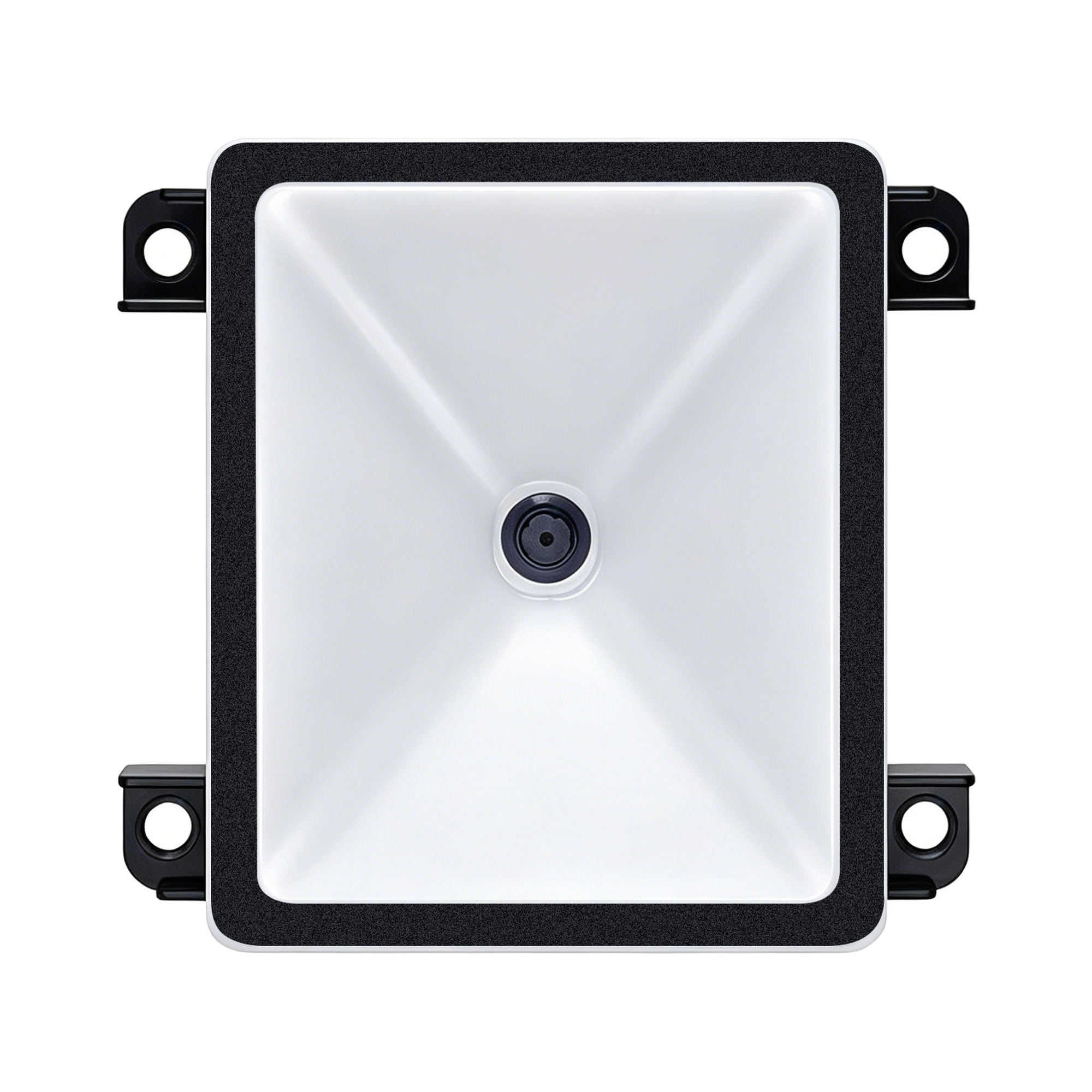
F42-NFC
Scan and NFC in one front window — for access panels and lockers that must read a badge and a code at the same station.
- 680×480 CMOS, 4 mil
- 2D depth of field up to 200 mm
- NFC 13.56 MHz, 0–40 mm
- 61.5×65×18.5 mm, 20 g
Reading laser DPM or shallow marks on metal? The G53-AI adds AI-based decoding for low-contrast and damaged codes — full specifications are on the product page.
Side-by-side
| Model | Sensor | Resolution | Working range | Field of view | Interface | Size / weight |
|---|---|---|---|---|---|---|
| G4503 | 1600×1200 CMOS | 1D ≥3.3 mil / 2D ≥5 mil | 40–300 mm (13 mil) 30–300 mm (payment code) | ±43° / ±33° | USB / TTL / RS232 | 49×21×16.8 mm / 75 g |
| F4100 | 800×600 CMOS | 1D ≥3.3 mil / 2D ≥5 mil | 40–200 mm (13 mil) 30–250 mm (payment code) | ±65° / ±50° | USB / TTL232 / RS232 | 65×61.2×37.5 mm / 30 g |
| F42-NFC | 680×480 CMOS | 4 mil | 2D up to 200 mm | 74.8° H / 46.2° V | USB (HID/CDC) / TTL232 / RS232 | 61.5×65×18.5 mm / 20 g |
| G53-AI | AI decoding module | See product page | See product page | See product page | USB / TTL / RS232 | See product page |
Specifications above are taken from the current datasheets; confirm the final configuration against the drawing before tooling.
Where it goes
3C assembly and test fixtures. A compact head fits inside a jig where a handheld cannot reach, and reads the board code on every cycle.
Conveyor and sorting lines. Mount above or beside the belt with a sensor trigger; set the exposure for belt speed rather than for a stationary part.
Lockers, kiosks and vending. The reader sits behind glass or acrylic; keep the window thin and parallel, and check the working range through the actual window, not in free air.
Metal parts and DPM. Angle the head 10–15° off the surface normal to move the specular reflection away from the lens, and grade the mark before choosing the engine.
Integration checklist
- Measure the real window-to-code distance across the full part tolerance, not just the nominal position.
- Test with the customer's own codes — at least 200 reads per code type — and count misses and misreads separately.
- Grade 2D and DPM marks to ISO/IEC 15415 or 29158 before blaming the reader.
- Leave 10–15 mm behind the connector for the FPC or cable bend radius.
- Decide the trigger source (PLC command, photoelectric sensor, continuous) before wiring the station.
- Check ambient light at the actual position: all models are rated to 100,000 lux, but direct sunlight on the window still needs a hood.
Need a different footprint?
If the standard housing does not fit, we rework the PCB outline, connector type, cable exit direction and firmware protocol. See OEM / ODM scan engine customization for the process, or read the DPM reading guide before specifying a mark.
Get a Quote / Ask a Question
Tell us the model(s) and quantities you need — we usually reply within one business day. Business buyers only; your details are never shared.