F42-NFC: One Module for Barcode Scanning and Card Reading
An access gate needs a card reader; a self-service terminal needs a barcode scanner. Too many projects end up with two boards inside one enclosure - two cutouts, two cables, two firmware paths, and twice the troubleshooting. F42-NFC puts both functions on a single 61.5 x 65 x 18.5 mm board: a 13.56 MHz card reader and a 680x480 imaging scanner sharing one window, one cable and one protocol.
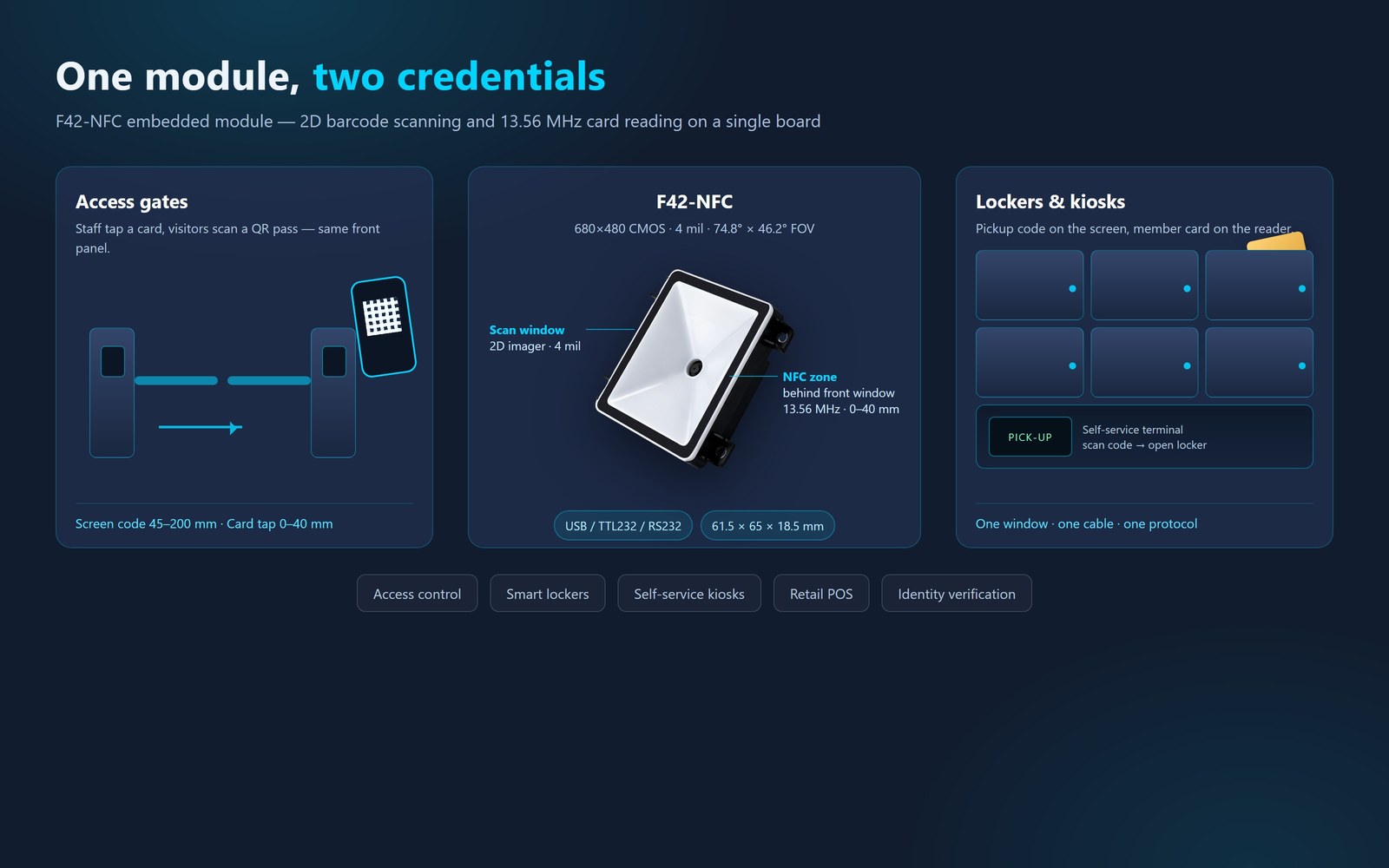
F42-NFC · one front window handles both scanning and card reading, so gates, kiosks and lockers share the same mechanical design
1. When do you actually need both?
Not every device does. But if any of these combinations appears, a combined module earns its place:
- Access gates: staff tap a card, visitors scan a QR code on the same panel
- Smart lockers: pickup by phone code, membership by physical card
- Government, hospital and hotel kiosks: booking codes, membership cards and visitor passes in one session
- Retail POS and identity checks: loyalty code plus loyalty card without a second device on the counter
The hidden cost of the two-board approach is mechanical: two openings, two sealing steps, two harnesses and two update paths. With one module the mechanical engineer details one window and the production line assembles it once.
2. Key specifications
| Item | Value |
|---|---|
| Image sensor | 680x480 CMOS |
| Precision | 4 mil |
| Field of view | 74.8 deg (H) x 46.2 deg (V) |
| Roll / pitch / skew | 360 deg / +/-50 deg / +/-50 deg |
| Print contrast | 20% minimum |
| Ambient light | 0-100,000 lux |
| NFC frequency and range | 13.56 MHz, 0-40 mm |
| Supported cards | S50/S70, NTAG 213/215, Mifare Ultralight, Fudan M1, Desfire EV1-EV3, Mifare Plus 2K/4K, SR176, 15693 |
| Depth of field (QR 15 mil) | 25-140 mm |
| Depth of field (EAN-13 13 mil) | 25-150 mm |
| Depth of field (PDF417 6.67 mil) | 40-90 mm |
| Depth of field (screen codes) | 45-200 mm |
| Interfaces | USB (HID/CDC/HIDPOS), TTL232, RS232 |
| Power | DC 3.3-5.5 V, about 300 mA at 5 V (1.5 W) |
| Size / weight | 61.5 x 65 x 18.5 mm / 20 g |
The camera module can be swapped per project, which matters for custom builds: keep the same enclosure and change the optics to cover close-up labels or screen codes read from further away.
3. Four application trade-offs
Access gates and turnstiles
A 0-40 mm card range means the user taps the panel; it is not a hands-free reader. Put the card zone on the front face and let the phone QR code work at 45-200 mm, which is comfortable for a visitor raising a phone.
Smart lockers
Locker doors are usually acrylic or tempered glass. Window thickness directly reduces both card range and image quality, so test anything above 3 mm. Metal cabinets also need a non-metal gap behind the module or the card range collapses.
Self-service terminals
Government, hospital and hotel kiosks often need ID documents too. F42-NFC handles codes and cards; add a separate MRZ or ID module for documents rather than expecting one board to do everything.
Retail POS and identity verification
Checkout lighting is harsh and label quality varies. The 20% print contrast rating covers most worn coupons and receipts, but add a hood where strong backlight is unavoidable.
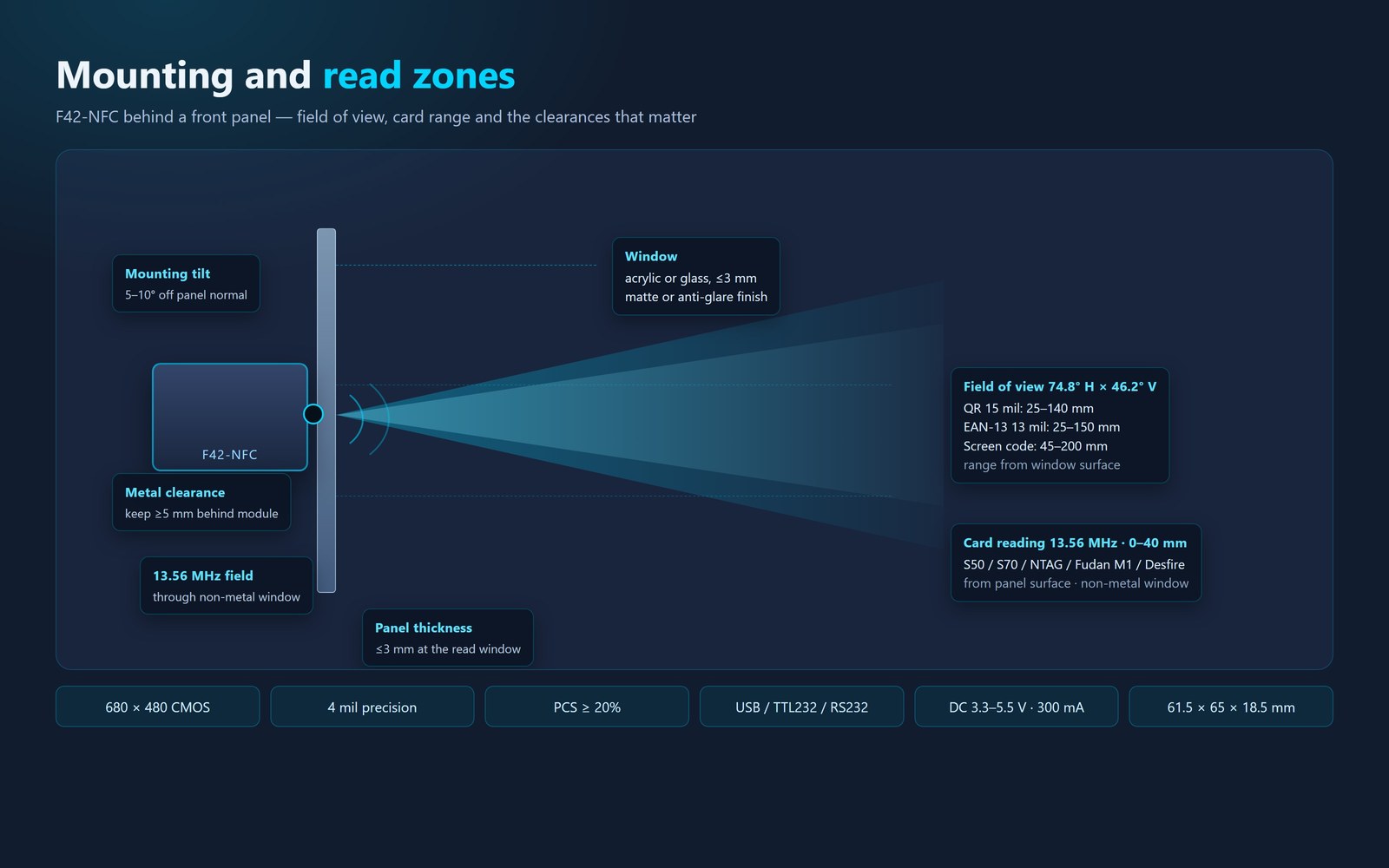
Mounting cross-section: the scanner field of view and the 13.56 MHz card field both pass through the same non-metal window
4. Four selection mistakes
- Expecting a longer card range. 0-40 mm is a tap distance, not 10 cm through air. A longer range needs a larger antenna design, not a parameter change.
- Not confirming card types first. S50/S70, NTAG and Desfire cover access and membership cards. Financial IC cards and social security cards use the CPU-card stack and are outside this module's scope.
- Designing paper and screen codes for the same distance. Screen codes want 45-200 mm, printed 13 mil labels 25-150 mm. Size the opening for the furthest case.
- Mismatching the interface. USB HID is driver-free and simplest; TTL232 suits embedded host boards; RS232 suits long cable runs and industrial cabinets.
5. Installation and commissioning notes
- Window size: the opening must exceed the field of view, with a light-blocking edge so side light does not reach the lens
- Panel thickness: keep acrylic at or below 3 mm; thicker panels cost both card range and image quality
- Mounting angle: tilt 5-10 degrees up from vertical to avoid ceiling downlights
- Reflections: use matte or anti-glare film on glossy panels - mirror reflections stop screen codes dead
- Metal surroundings: leave at least 5 mm of non-metal clearance behind the module
- Side by side units: keep NFC antennas at least 10 cm apart to avoid mutual interference
- Commissioning order: cards first, then screen codes, then printed labels; test each at a fixed distance and log the result so you can tell a mechanical problem from a settings problem
6. Common problems
Screen codes fail. Check brightness, privacy film and distance first, then exposure and gain; confirm the code sits within 45-200 mm.
Cards do not read. Confirm the card is 13.56 MHz - 125 kHz low-frequency badges are not compatible - then check for metal behind the antenna.
Intermittent reads. Usually a thick panel or an unstable tap angle; a printed locator ring or a recess fixes most cases.
Scanning and card reading interfere. Time-share the two functions instead of running the antenna and imager at full load together.
If you are selecting a module now, send us the panel drawing, card types and target distance. We will suggest an opening and arrange a sample for testing on your own enclosure.
Related technical articles
Not sure about the cut-out or reading distance?
Tell us the device type, panel size and the codes you need to read. Free sample evaluation — order once the read rate works for you.
📞 Contact Xinlong IoT