XL-B4 Embedded Scan Engine: Barcode Reading for Retail Price Checkers
A price checker is the least demanding device in the store and the most demanding on its scanner: a shopper drops a product in front of the window and expects the price, stock and promotion instantly. XL-B4 packs a 640 x 480 reading core into a 41 x 22.99 mm front face with built-in infrared sensing, so the engine wakes up as an item approaches.
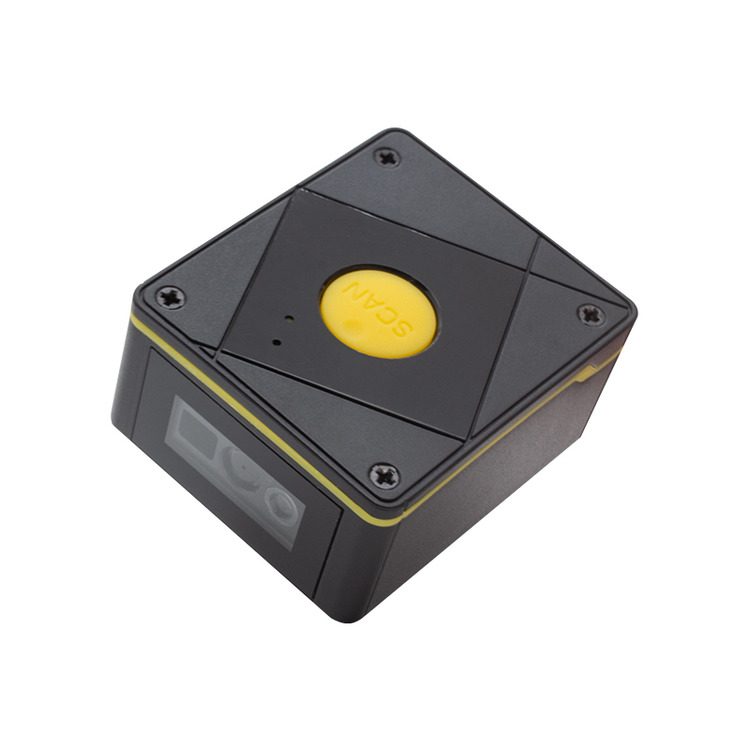
XL-B4 · 41 x 22.99 mm front face, 90 g, 26 mm mounting pitch
1. Why a price checker needs an embedded engine
Floor-standing price checkers, fitting-room lookup screens and self-service desks share three constraints: a narrow panel, a flat front face and hundreds of daily contacts. A handheld scanner bolted to the side protrudes, leaves its cable exposed and gets pulled off. An embedded engine makes the scan window part of the housing: no moving parts, no external cable, one wipe to clean and far less assembly time.
2. Three things that actually go wrong in a store
Lighting is harsher than an office
Track lights, LED strips and shop windows hit the panel, and laminated labels reflect them. XL-B4 works from 0 to 100,000 LUX ambient light and reads print contrast down to 20%, which covers paper labels and thermal price tags.
Shoppers do not square up the barcode
Items arrive sideways, tilted or pushed past the window. The engine offers 360° rotation and ±50° pitch and skew, with a 40-300 mm depth of field: an EAN-13 label at 12 mil reads at 60-220 mm, a 10 mil screen code such as a membership QR at 40-140 mm.
Thousands of reads a day, with nobody pressing a button
A price checker has no cashier to pull a trigger, so detection must be automatic. The built-in infrared sensor triggers at 140 mm; standby current is 30 mA, operating current 220 mA and maximum power 1.2 W, so a unit powered all day does not build up heat.
3. Key specifications
| Item | Specification |
|---|---|
| Image sensor | CMOS 640 x 480 |
| Min. resolution | 5 mil |
| Depth of field | 40-300 mm (EAN-13 12 mil: 60-220 mm) |
| Ambient light | 0-100,000 LUX |
| Rotation / pitch / skew | 360° / ±50° / ±50° |
| Infrared sensing | 140 mm trigger distance |
| Power | DC 5 V, 220 mA operating, 30 mA standby, 1.2 W max. |
| Dimensions | Front 41 x 22.99 mm, side 48.8 x 26 mm, 90 g, 26 mm hole pitch |
| Environment | -20 to +60 °C, 5-95% RH non-condensing |
| Symbologies | QR, Data Matrix, PDF417, Aztec, Han Xin, GM; Code 128, EAN-13/8, Code 39, UPC, Codabar, China Post and more |
4. Four design points for the housing
Use a single-layer window
Choose one high-transmission panel rather than two stacked sheets, which can produce a double image under bright light. Leave 3-5 mm between the window and the lens so a pressed panel cannot touch the optics, and cut the opening slightly larger than the field of view with rounded corners.
Keep the usual scan height inside the depth of field
The scan surface of a price checker usually sits 900-1100 mm above the floor, and shoppers hold an item 60-180 mm from the window, which lands in the middle of the 40-300 mm range. Tilting the engine down by 10-15° helps keep the label parallel to the window.
Give the IR sensor its own opening
At 140 mm the sensor is a proximity trigger, so its window must not be covered by the panel or exposed to direct spotlight or sunlight, or the unit will trigger continuously with nobody in front of it. A separate opening with a short light shield solves both cases.
Configure before shipping
Set enabled symbologies, prefixes and suffixes, beeper and illumination behaviour to match the store POS rules during production. Firmware can be upgraded later, so a change of output format does not require opening the housing. Most price checkers only return the item barcode, so keeping the data string clean is the simplest choice.
5. Choosing between similar engines
Need higher resolution with USB, TTL232 and RS232 on one board? See F4100 (800 x 600 CMOS, 65 x 61.2 x 37.5 mm). Thumbnail-sized space with a TTL or USB host? See XL-M100P (21.7 x 7.2 x 9 mm). Panel depth limited to 11.9 mm? See E600. For a flush panel, automatic wake-up and mid-range reading, XL-B4 is the closest match; the full comparison is in the model specification table.
6. Checklist before you build
Confirm the panel material and 41 x 22.99 mm cut-out, typical reading distance against the 40-300 mm range, store light levels, whether membership QR or e-coupons must be read, the host interface, and whether a custom housing or firmware is needed.
Related Products
Related Articles
Not sure about the cut-out or reading distance?
Tell us the device type, panel size and the codes you need to read. Free sample evaluation — order once the read rate works for you.
📞 Contact Xinlong IoT