XL-P168-NFC Desktop Payment Box: Payment Codes and NFC at One Counter
A checkout counter has to read two things: the payment code on the customer's phone, and the membership or stored-value card in their hand. Most shops use a scanner plus a separate card reader — two cables and two aiming points. XL-P168-NFC puts payment-code reading and NFC in one desktop box, so a single placement handles both.
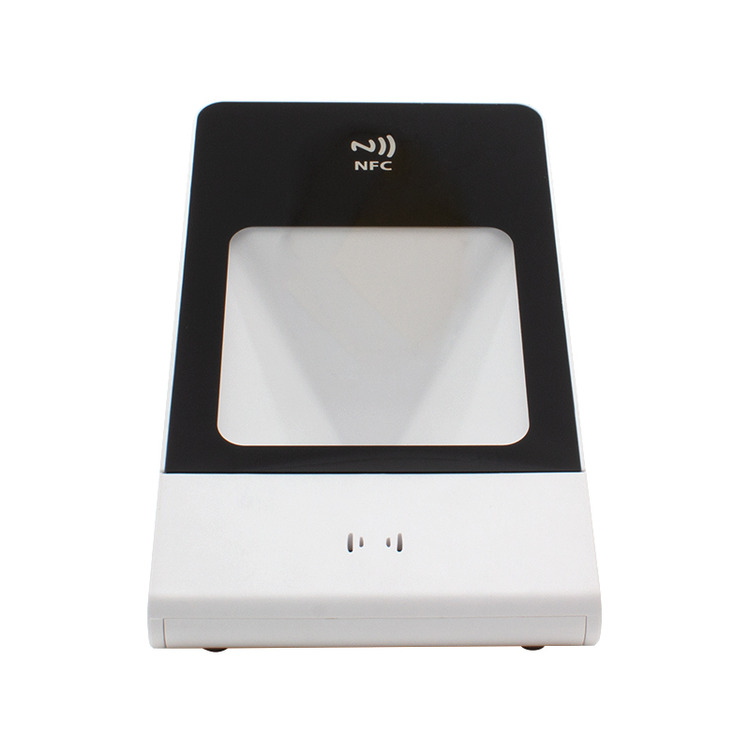
XL-P168-NFC: desktop wedge, 140 x 80 x 100 mm, black tilted panel with a square scan window
1. Why one window for both credentials
Counter space is limited and staff do not want to swap devices mid-transaction. Putting the NFC coil and the scan window in one upright box means the customer simply holds a phone or card over the window. The face is tilted and the window points upward, so customers can aim it themselves without the cashier reaching across. Voice prompts confirm every payment and card read, which matters during a rush when nobody is watching the screen.
2. Five typical deployments
Convenience stores and community supermarkets
12-200 mm depth of field reads a payment code held high or low; a membership card tapped on the same window earns points or pays from a stored balance.
Pharmacies and chain stores
One counter position handles prescription codes, payment codes and membership cards instead of three separate terminals.
Quick-service restaurants and tea shops
The upright wedge footprint fits beside a pickup counter or cup rack, and keeps reading codes through a peak without stalling.
Hospital cashier and report desks
Patient and health cards read over NFC while mobile payment uses the scan window, so registration, payment and report collection finish at one desk.
Ticketing, venues and exhibitions
Tickets and coupons usually live on phone screens, where on-screen codes stay readable; staff badges and physical passes are tapped on the same window.
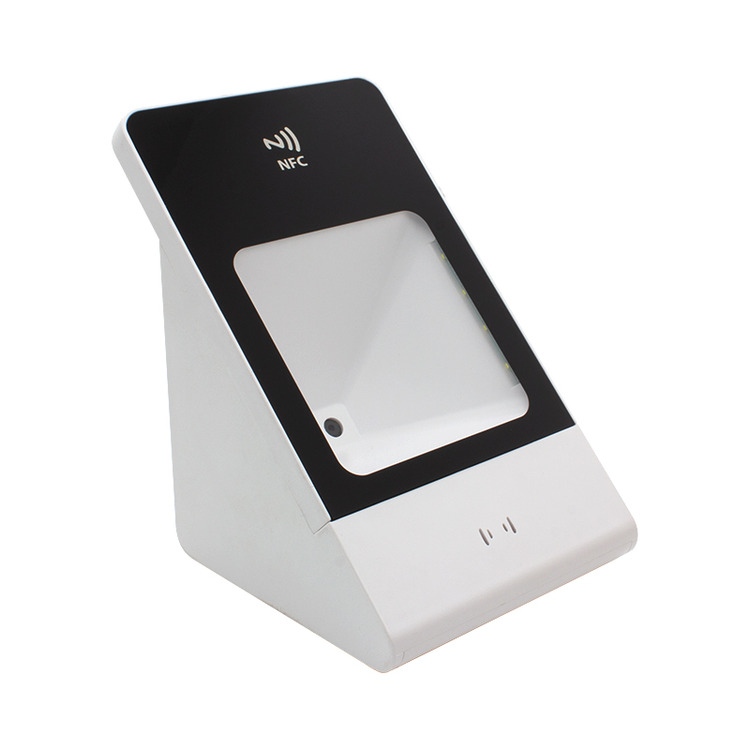
Payment code and NFC card read through the same window
3. Reading and NFC specifications
The reading core is a 640 x 480 CMOS sensor at 30 FPS with 6500 K white LED illumination, a 74° horizontal and 58° vertical field of view, 360° rotation and ±60° tilt and skew. Depth of field is 12-200 mm for payment codes and 40-65 mm for refund codes, with 5 mil 1D and 10 mil 2D precision and motion tolerance of at least 80 cm/s, enough for a code moving on a phone screen. EAN13, CODE128, CODE39, QR, PDF417 and DataMatrix are enabled by default; interleaved 2 of 5 and MSI are off unless a project asks for them.
NFC covers Mifare-compatible cards, ISO/IEC 14443A cards and NFC phones, with continuous or command-driven reading plus configurable prefixes, suffixes and terminators, so the POS software receives a card number it can match directly.
4. Housing, power and interfaces
The unit measures 140 x 80 x 100 mm and weighs 195 g in an ABS housing with an anti-slip silicone base. It runs on 5 V 1 A, drawing 360 mA while working and 160 mA on standby. Interfaces include HID-KBW (default, driver-free keyboard output), HID-POS, USB virtual COM and TTL232, so it connects to a POS terminal, an all-in-one register or an industrial PC without extra software. The housing is IP54 rated, survives a 1.5 m free fall and operates from -20°C to 60°C.
5. Desktop box or embedded module?
If the counter and the register already exist, a desktop box is the fastest route: no structural change, no cabinet work, just a USB connection. If the hardware is a kiosk, gate or locker, the panel has to stay flat, so an embedded module is the better fit — F21-NFC for standard cut-outs, or XL-F24MINI-NFC where only a 53.5 x 36 mm face is available. The question to settle first is whether the device already has a cut-out for a module.
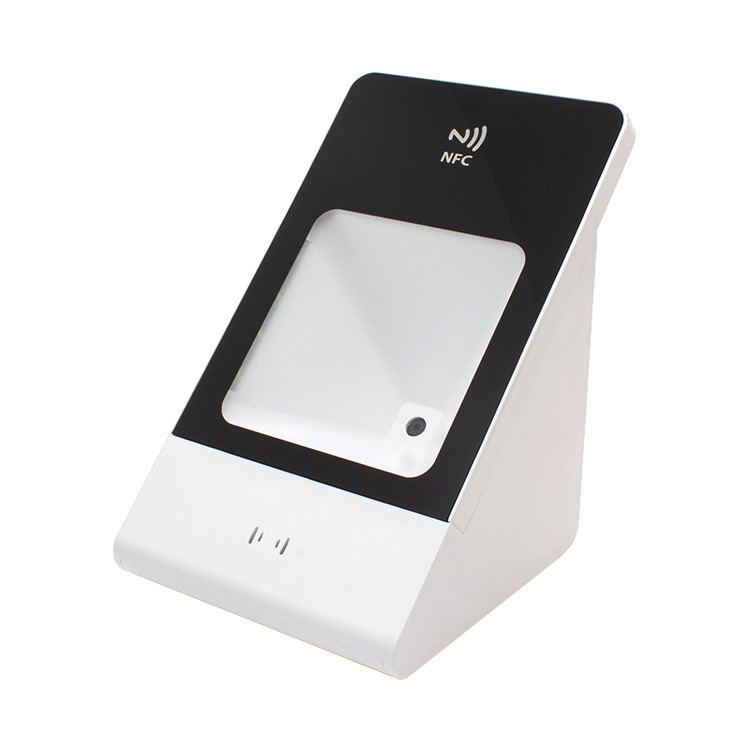
Rear communication port; USB into a register outputs HID-KBW by default
6. Three questions before choosing
Which codes will it read: payment, refund, coupon or pickup codes, since depth of field and default symbologies differ. Which cards: Mifare-compatible, ISO/IEC 14443A or phone NFC, which decides the reading mode. And how the POS software connects: keyboard output is simplest, while card parsing points to USB virtual COM.
Full specifications and drawings are in the XL-P168-NFC brochure. If a project needs both payment codes and cards, send us the code types, counter dimensions and POS interface, and we will ship a sample for testing first.
Related Products
Related Articles
Reading payment codes and cards at the same counter?
Send us the code types, counter dimensions and POS interface. We ship free samples for testing.
📞 Contact Xinlong IoT