XL-S20-AI: Unit-Level Traceability in 3C Electronics
Warehouse scanning is about cartons — get one wrong and you scan it again. A 3C line scans every board, every mid-frame, every connector. One bad read and the serial number no longer matches what was actually assembled. XL-S20-AI is built for that step: a 1296×816 CMOS sensor with AI decoding and red/white illumination, aimed at DPM, low-contrast and micro codes.
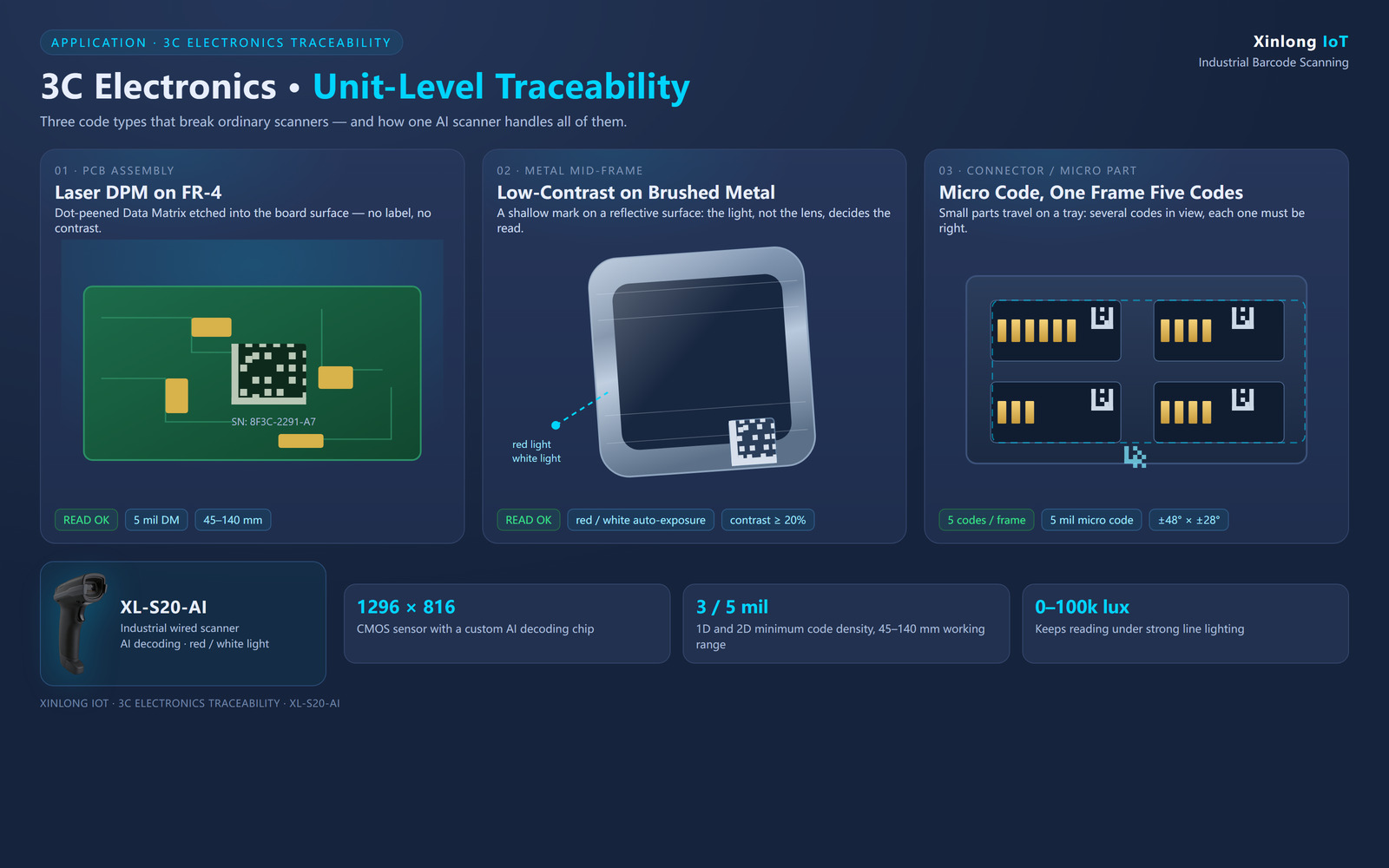
Three code types on a 3C line: laser DPM on PCB, shallow marks on metal, 5 mil micro codes in a tray
1. Why unit-level, not batch-level
OEMs no longer accept batch traceability from their suppliers. Every board, frame and connector has to resolve back to a production lot, a station, an operator and the test data for that unit. Recalls shrink from a month of output to a single lot; yield analysis points at a station instead of a whole line. Scanning looks like a small step, but everything upstream depends on it.
2. Four codes that break ordinary scanners
Laser DPM on PCB. To save label space and cost, the Data Matrix on a main board or FPC is usually laser-etched straight into the surface: no label, no black-on-white contrast, just depth.
Metal mid-frames. Anodised or brushed surfaces reflect light and the mark is shallow. Change the angle and a conventional scanner simply loses it.
Connectors and camera modules. Codes of 3–5 mil on a part a few millimetres across. If the sensor cannot resolve it, the operator sees a blur.
Several codes per frame. A tray carries four or five parts at once. Miss one and the binding between parts and the finished unit is wrong.
3. How the XL-S20-AI handles them
Low contrast: red and white illumination by default, with smart AE that picks the light for the scene and remembers the best setting. Inverted marks, tilted DPM and shallow etching are solved by switching illumination and letting the algorithm decide — not by simply raising gain.
Multiple codes: up to 5 barcodes decoded in a single frame, so a tray does not have to be aligned part by part.
Distance: 45–140 mm for Data Matrix 10 mil, 50–110 mm for Code 128 at 3.3 mil, 45–110 mm for PDF417 5 mil. Those three numbers decide how the station is built — the window-to-code distance has to sit inside the range, not "about right".
| Item | Specification |
|---|---|
| Image sensor | 1296 × 816 CMOS with a custom AI decoding chip |
| Accuracy | 1D ≥ 3 mil / 2D ≥ 5 mil |
| Illumination | White + red, red cross-hair aiming |
| Depth of field | DM 10 mil 45–140 mm / Code 128 3.3 mil 50–110 mm / PDF417 5 mil 45–110 mm |
| Field of view | ±48° H / ±28° V |
| Print contrast | ≥ 20% |
| Roll / pitch / yaw | ±360° / ±60° / ±60° |
| Interfaces | USB (default) / TTL / RS232 |
| Power | 5 V DC, approx. 500 mA |
| Operating temp / humidity | −20 °C to +50 °C / 5%–95% non-condensing |
| Ambient light | 0–100,000 lux |
| Size / weight | 171 × 81 × 68 mm / 140 g |
USB is the default; TTL and RS232 are available for older stations or PLCs. Swapping the interface does not mean swapping the gun, which keeps spares simple.
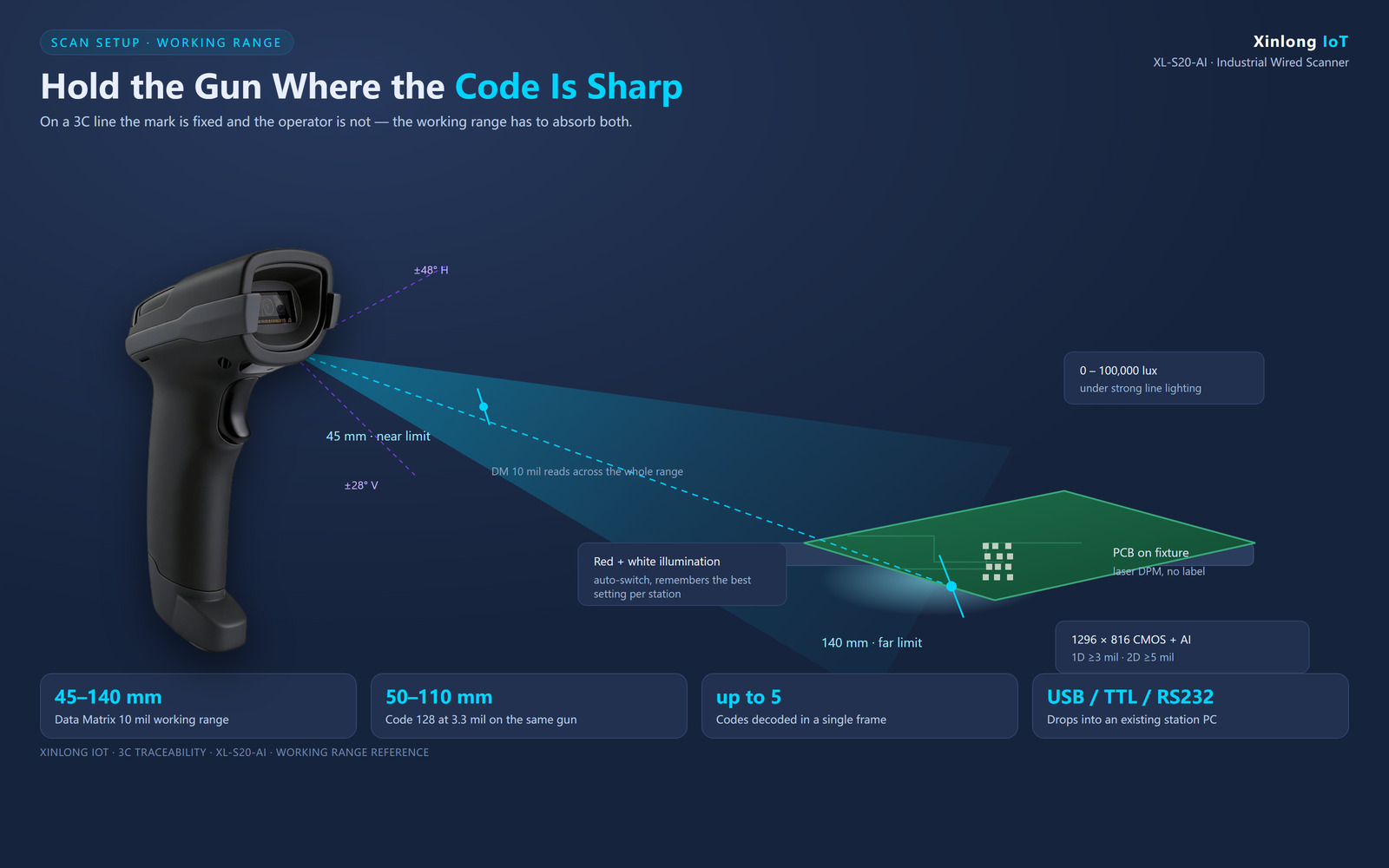
Keep the window-to-code distance inside 45–140 mm for DM 10 mil
4. Four things to settle at the station
Fix the distance. A handheld gun drifts out of its depth of field very easily. A simple stop or bracket that holds the window 60–100 mm from the code makes the whole setup far more forgiving.
Grade the code before you go live. Run ISO/IEC 15415 (2D) or 29158 (DPM) grading once. Below grade C on a DPM mark, every scanner will miss reads — the problem is the marking parameters, not the reader.
Write the binding rules. With five codes in a frame, decide which is the part code, which is the tray code, and whether a missed read stops the line or passes. The gun reads and sends over USB HID, TTL or RS232; the logic stays in the MES.
Watch the part angle. A metal part facing the light directly returns a mirror reflection that washes the code out. Tilting the part 10–15° off the optical axis, or adding a diffuser, often does more than changing hardware.
5. How to validate before buying
Do not choose from a datasheet. Take three real samples: a PCB with a laser DPM mark, a brushed metal frame, and a tray of 5 mil connector codes. Scan each 200 times at the same station and lighting, and count misses and misreads separately. Misses are usually illumination and exposure — fixable. Misreads are the dangerous ones: they never raise an alarm, they just write the wrong serial number into the system.
6. Closing
The hard part of 3C traceability is not reading a code — it is reading it consistently and being able to prove it. An AI-decoding gun with dual illumination removes most of the intermittent no-reads on the floor. The rest comes down to code quality, station distance and process rules. The XL-S20-AI covers the first half; the second half is decided together with the line.
If you are specifying a reader for a 3C line, send us the code type, the marking method, the station distance and the cycle time — we will recommend a model and arrange a sample test.
Related reading
Not sure which reader fits your line?
Send the code type, marking method and working distance. Free sample test — order once the read rate is proven.
📞 Contact Xinlong IoT